This guide looks at current technologies, incentive programs, regulations and policies promoting efficient water use in Colorado, with sections focused on municipal, industrial and agricultural water use.
Not a “how-to” book, but a reference for anyone seeking a balanced overview of the opportunities and challenges for water conservation in Colorado today.
Click on the photo below to access the 36-page document online!
Thank you to everyone who contributed information, time and resources into this valuable resource update. The update streamlines the original fourteen best practices into seven updated best practices that reflect how water conservation has evolved over the last 10+ years and the industry’s current landscape. Geared toward water conservation professionals, each best practice includes information on why the best practice is important, implementation considerations, water saving estimates and costs, as well as case studies, examples, and additional resources.
This project was funded with support from the Colorado Water Conservation (CWCB) and the Colorado River District.
Click on the photo below to access the 207-page document online!
Beginning in fall 2022, Colorado WaterWise has been working on an update to the 2010 Guidebook and Technical Guide. This brought the guidebook up to date with the latest best practices and new technologies that have developed or evolved over the last 10 years. The updated guidebook will be readily accessible to the public on the Colorado WaterWise website.
This Guidebook update is made possible through two grants through the Colorado Water Conservation Board and the Colorado River District (Community Funding Partnership).
Drought is more than just a lack of rain—it’s a multifaceted phenomenon that touches all aspects of society, the environment, and the economy. Understanding drought more deeply can help us better prepare for and respond to its impacts in the Upper Gunnison River Basin.
What is drought?
Research in the early 1980s uncovered more than 150 published definitions of drought. The definitions reflect differences in regions, needs, and disciplinary approaches.
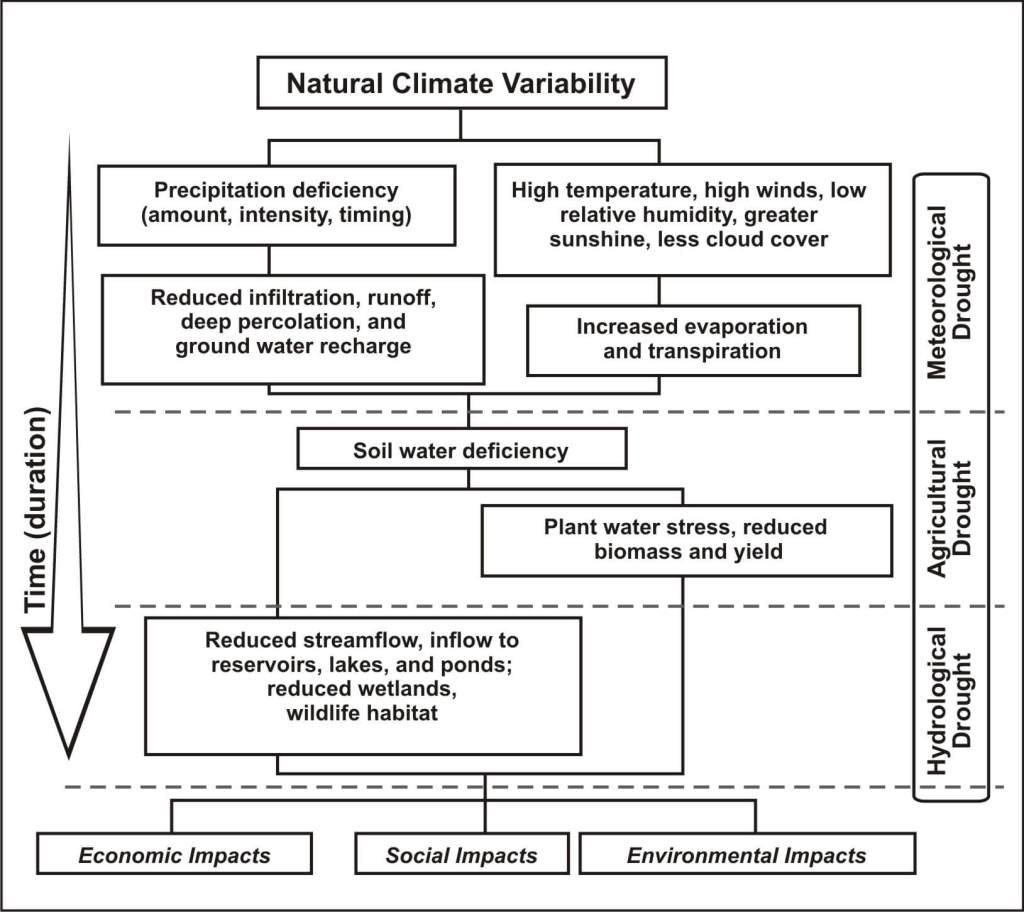
Wilhite and Glantz1 categorized the definitions in terms of four basic approaches to measuring drought: meteorological, hydrological, agricultural, and socioeconomic. The first three approaches deal with ways to measure drought as a physical phenomenon. The last deals with drought in terms of supply and demand, tracking the effects of water shortfall as it ripples through socioeconomic systems.
Drought occurs when there is a significant and prolonged imbalance between precipitation and water demand. Unlike other natural disasters, drought typically develops slowly and can persist for months or years. Its effects can be subtle at first but become increasingly severe as water shortages intensify.
Defining drought can be complex because it is not just a physical phenomenon—it is also a societal and environmental issue. While a lack of rainfall is often associated with drought, it can also result from increased evaporation due to higher temperatures, changes in land use, and shifts in water management practices.
Scientists describe drought conceptually, as an idea or concept; and operationally, by how drought functions or operates in ways that can be measured.
Conceptual definitions
Conceptual definitions of drought offer a general idea or concept of drought. For example, a conceptual definition of drought related to farming could be:
Drought is a protracted period of deficient precipitation resulting in extensive damage to crops, and a consequential loss of yield.
Conceptual definitions may also be important in establishing drought policy. For example, Australian drought policy incorporates an understanding of normal climate variability into its definition of drought. The country provides financial assistance to farmers only under “exceptional drought circumstances,” when drought conditions are beyond those that could be considered part of normal risk management. Declarations of exceptional drought are based on science-driven assessments. Previously, when drought policy was less well defined and less well understood by farmers, some farmers in the semiarid Australian climate claimed drought assistance every few years.
Operational definitions
Operational definitions help define the onset, severity, and end of droughts, how a drought functions or operates. No single operational definition of drought applies to all circumstances. This is a big part of why policy makers, resource planners, and others have more trouble recognizing and planning for drought than they do for other natural disasters. In fact, most drought planners now rely on mathematic indices to decide when to start implementing water conservation or drought response measures.
To determine the beginning of drought, operational definitions specify the degree of departure from the average of precipitation, or some other climatic variable, over some time period. This is usually done by comparing the current situation to the historical average, often based on a 30-year period of record. The threshold identified as the beginning of a drought (e.g., 75% of average precipitation over a specified time period) is usually established somewhat arbitrarily, rather than on the basis of its precise relationship to specific impacts.
An operational definition for agriculture might compare daily precipitation values to evapotranspiration rates to determine the rate of soil moisture depletion, then express these relationships in terms of drought effects on plant behavior (i.e., growth and yield) at various stages of crop development. A definition such as this one could be used in an operational assessment of drought severity and impacts by tracking meteorological variables, soil moisture, and crop conditions during the growing season, continually reevaluating the potential impact of these conditions on final yield.
Operational definitions can also be used to analyze drought frequency, severity, and duration for a given historical period. Such definitions, however, require weather data on hourly, daily, monthly, or other time scales and, possibly, impact data (e.g., crop yield), depending on the nature of the definition being applied. Developing a climatology of drought for a region provides a greater understanding of its characteristics and the probability of recurrence at various levels of severity. Information of this type is extremely beneficial in the development of response and mitigation strategies and preparedness plans.
Types of drought
Drought is a complex phenomenon with various forms, each affecting different aspects of the environment and society. Understanding the distinct types of drought helps us grasp its diverse impacts and informs our response strategies.
Meteorological drought
Defined by a prolonged period of below-average precipitation. Meteorological drought is region-specific—what constitutes drought in a typically wet area differs from what would be considered drought in a more arid region. In the Upper Gunnison River Basin, a season of insufficient snowpack can indicate meteorological drought.
Agricultural drought
Occurs when there is a shortage of moisture in the soil, disrupting crop growth and livestock production. Agricultural drought is often closely related to meteorological drought but can be influenced by farming practices and irrigation efficiency. In our region, reduced soil moisture can lead to diminished crop yields, stressed livestock, and increased operational costs.
Hydrological drought
Characterized by decreased water levels in rivers, streams, reservoirs, and aquifers. Hydrological drought often follows extended periods of meteorological drought, as it takes time for reduced precipitation to impact surface and groundwater systems. The Upper Gunnison River Basin may experience hydrological drought when water supplies in Blue Mesa Reservoir or local aquifers drop significantly.
Socioeconomic drought
Arises when water shortages begin to impact people, economies, and infrastructure. Socioeconomic drought links the physical aspects of drought to human activities and economic conditions. In our community, this could lead to water restrictions, higher costs for agricultural products, and losses in businesses reliant on outdoor recreation.
Ecological drought
A newer concept that considers the impact of drought on ecosystems. Ecological drought occurs when extended dry conditions reduce water availability for plants, wildlife, and aquatic habitats, leading to habitat degradation, decreased biodiversity, and heightened wildfire risks. This type of drought is significant in maintaining the health of our local ecosystems.
By recognizing these types of drought, we can better understand the challenges we face and take meaningful steps to mitigate their impacts.
What is climatology?
Climatology is the scientific study of long-term weather patterns and climate trends, typically spanning decades to centuries. Unlike meteorology, which focuses on short-term weather events like daily forecasts, climatology seeks to understand broader climate systems, their variability, and long-term changes.
Climatologists analyze extensive data from weather stations, satellites, and historical records to detect patterns and anomalies. These insights help to define regional climates, understand the factors that drive climate variability, and predict potential future changes. In the context of drought, climatology helps determine whether a dry period is a temporary fluctuation or part of a more significant trend.
For the Upper Gunnison River Basin, climatology plays a critical role in understanding how factors like temperature, precipitation, snowpack, and runoff patterns influence water availability. It also helps anticipate the potential impacts of large-scale phenomena like El Niño and La Niña, which can lead to significant shifts in precipitation and temperature patterns.
Climate change has further complicated our understanding of drought, as rising global temperatures can alter precipitation patterns, increase evaporation rates, and extend the duration and severity of dry periods. These changes emphasize the need for ongoing monitoring and adaptable water management practices.
By applying climatology to drought planning, we can better prepare for and respond to future drought conditions, helping safeguard our community’s resources and livelihoods.
Building understanding and resilience
By exploring the science of drought and understanding its types and causes, we can strengthen our community’s ability to cope with its impacts. The Upper Gunnison Drought Contingency Plan is committed to promoting awareness, fostering collaboration, and implementing strategies to manage and mitigate the effects of drought.
For more information and to stay updated on current drought conditions in the Upper Gunnison River Basin, sign up for the Upper Gunnison Drought Plan newsletter.



 Upper Gunnison Drought Plan