




Mitigation actions are activities that will build long-term resilience to drought, mitigate risks posed by drought, decrease sector vulnerabilities, and reduce the need for response actions.
These are long-term actions that water users, stakeholders, and the public implement to protect themselves from drought and drought impacts. They take place regardless of drought conditions and can take place at any time.
The potential mitigation actions are described herein in no particular order, and are designed to be implemented over the next several years to manage drought proactively, across agencies.
Education, Outreach, and Collaboration
This category represents actions focused on education and outreach needs, including the sharing of information and data.
E1 – Basin-Wide Action Plans
The Upper Gunnison River Basin has many existing community drought-related initiatives. This action supports continued engagement in workgroups and planning processes relating to drought mitigation.

Steps for Implementation
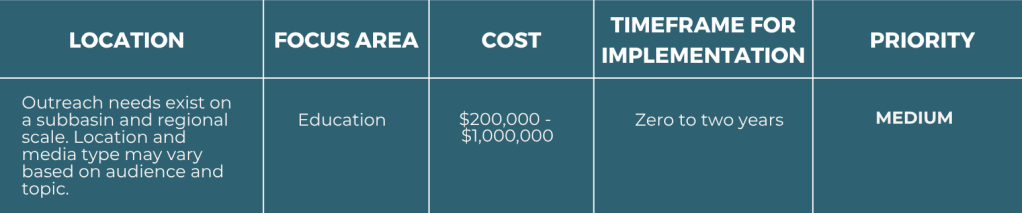
E2 – Drought Outreach Strategy
Develop outreach strategies for specific audiences and water sectors. Outreach needs range from sharing water supply forecasts to water administration to education.
Steps for Implementation
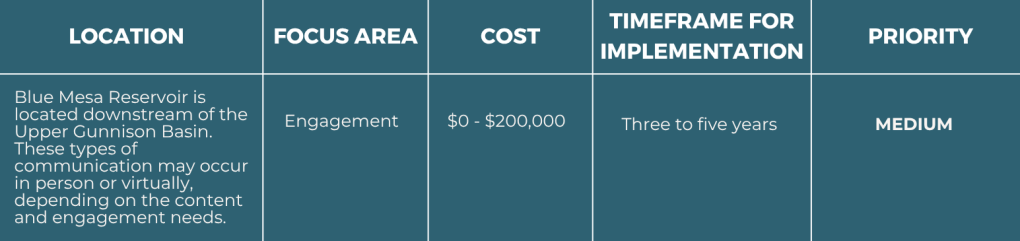
E3 – Blue Mesa Reservoir Coordination
Improve communication between the Bureau of Reclamation, Upper Gunnison Basin water users, and the public. The community seeks additional communication around annual operations, management of releases for Drought Response Emergency Releases, and operations associated with winter icing protocol(s).
Steps for Implementation
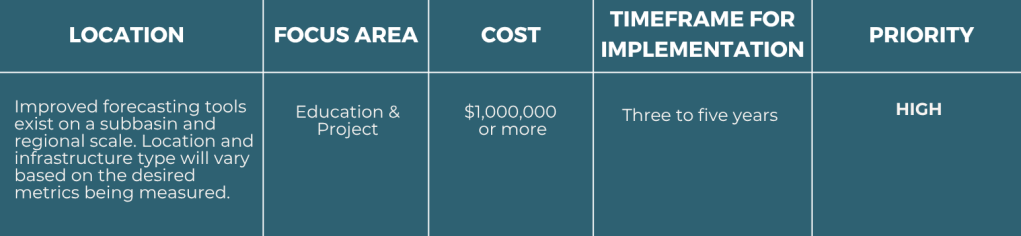
E4 – Water Supply Forecasting Tools
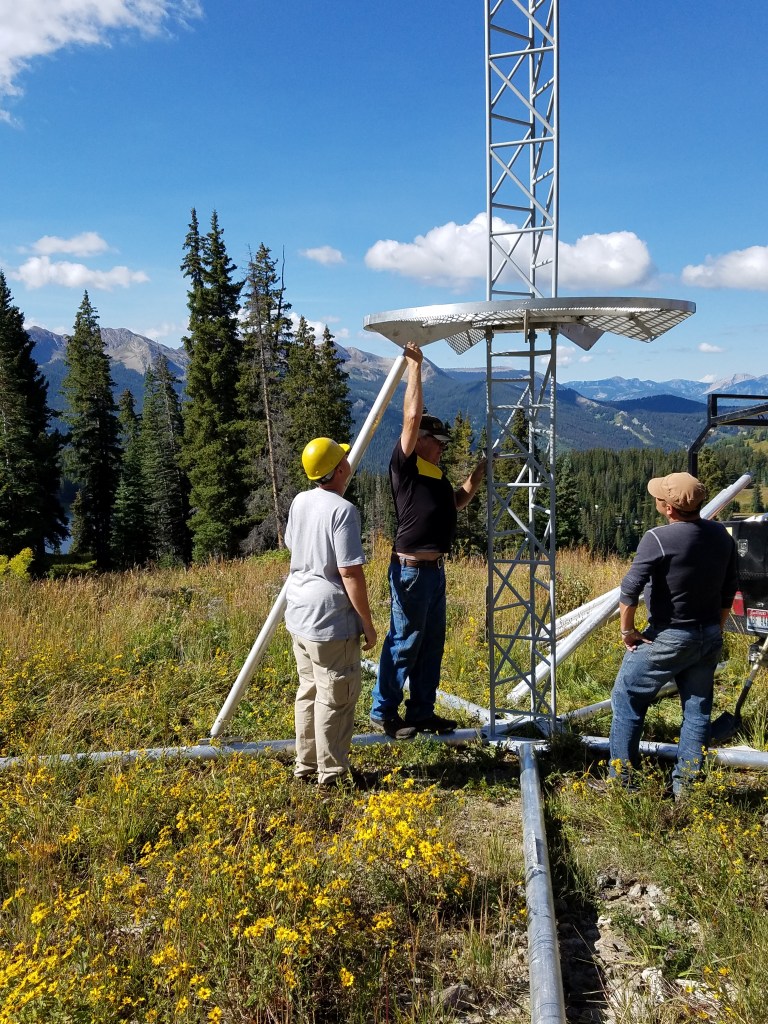
The UGDP recommends continued support to improve forecasting tools. Technologies, such as forecasting modeling, become more reliable as more data is collected, maintained over the long term, and shared broadly. While many of those tools exist, there is a need for additional information at both a local and regional scale. To improve these models, new infrastructure such as soil moisture monitoring sensors, stream gages, and/or Snow Telemtry (SNOTEL) sites should be installed and upgraded. In addition to on-the-ground data collection, emerging technologies such as Airborne Snow Observatories (ASO) flights[1] [2] and monitoring of dust-on-snow events should be incorporated into forecasting.
Steps for Implementation
Agriculture Resilience
This category represents actions focused on making agricultural water users resilient to drought. Actions range from infrastructure improvements to investigations of opportunities for collaboration.
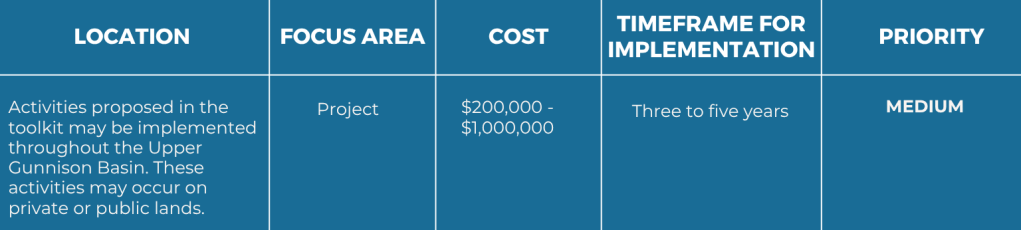
A1 – Agricultural Best Management Practices
The UGDP supports existing tools used for agricultural best management practices as well as the expansion of these activities. Programs and guidance are currently available through the NRCS, federal agencies, and Colorado State University Extension offices. This action identifies multiple activities that, when implemented, create drought resiliency.
This all-encompassing action emphasizes that there is no one-size-fits-all solution. The development of a functioning conditions assessment of various efforts could help identify priority areas and focus resources. These different approaches enable flexibility and adaptability in selecting the most suitable actions for specific contexts. This action encompasses three key areas of focus: food supply (rangeland, irrigated pasture, baled hay), water management on public lands, and public land management.
Steps for Implementation
A2 – Agricultural Infrastructure and Water Management Improvement
The UGDP supports implementing activities that improve irrigation water delivery and on-ranch efficiencies. This action proposes improving agricultural delivery infrastructure where appropriate. These improvements could include headgate and diversion upgrades, automation, auto tarps, soil moisture sensors, ditch lining, and other enhancements. On-ranch efficiency improvements could focus on improving irrigation application types, drought tolerant pasture mixes, and other management needs.

Steps for Implementation
A3 – Irrigation Return Flow Study
The UGDP supports the ongoing study of flood irrigation practices and basin return flow dynamics and their potential impacts on groundwater and surface water interactions in the Upper Gunnison River Basin. The objective of this study is to characterize and model surface water and groundwater interactions in the Upper Gunnison River Basin with a focus on agricultural return flows in the assessed reach(s).
The proposed study will rely on integrated groundwater monitoring, surface-water monitoring, geochemical data collection, interpretation, and modeling.

Steps for Implementation
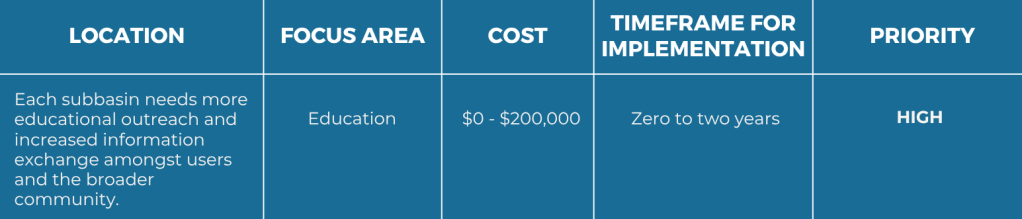
A4 – Agricultural Communication and Education
The goal of this action is to support the agricultural community by increasing general public awareness around agriculture in the basin, providing opportunities for producers to share their knowledge, and developing new educational materials that are tailored to producers in the Upper Gunnison River Basin. For example, many ranchers and land managers rely on subbasin and regional data to make decisions.
This action seeks to make this data more widely available and accessible, especially to newcomers to the basin. This action will raise awareness of opportunities for the agricultural community to work with partners in implementing programs that support improved management practices and drought resilience.
Steps for Implementation
Environmental Resilience
This category represents actions focused on restoring natural habitats, addressing environmental needs, and engaging communities.
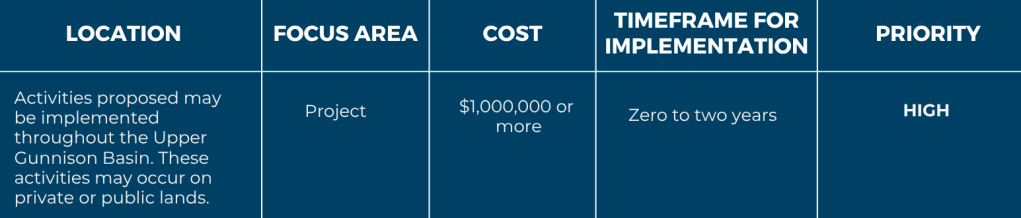
W1 – Watershed Restoration Activities
The UGDP supports the implementation of activities that create drought resilience in natural meadows, riparian zones, and other habitats within the Upper Gunnison River Basin. Existing activities include erosion control, wet meadows restoration, cheatgrass treatment, and low-tech process-based restoration efforts. These activities focus on habitat resilience across the landscape.
Steps for Implementation
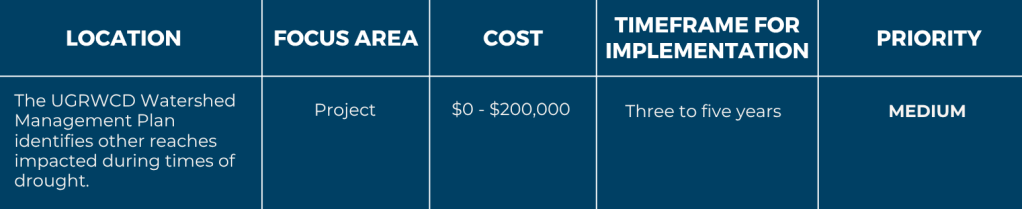
W2 – Coordinated Water Conservation
The UGDP supports continued community-driven, voluntary coordination among water users in areas that experience frequent diminished streamflow during times of drought. A 2018 pilot project led by Trout Unlimited at the Tomichi Creek State Wildlife Area (SWA) serves as an example. The project included six participating irrigation diversions, extensive surface and groundwater modeling, and a voluntary water leasing mechanism to provide short-term relief to the stressful conditions in the fishery that were attributed to drought.
There are numerous lessons learned from the project that can be applied to future opportunities. The pilot project demonstrates that cooperation between different types of water users can find mutually beneficial solutions.
Steps for Implementation
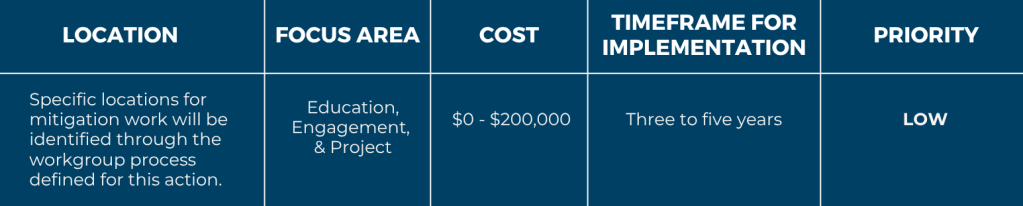
W3 – Mitigating Water Quality Impacts
The UGDP supports implementing activities that eliminate or reduce water quality impacts during drought. For example, activities could focus on improving discharge concentrations from mining sites without point source discharge permits. Another opportunity could be to work with existing point-source discharge permit holders to ensure requirements are met in times of drought.
Steps for Implementation
Recreational Resilience
This category represents actions focused on addressing recreational needs and engaging communities.
R1 – Resilience Among Recreation Service Providers
The UGDP supports investigating opportunities to help recreation service providers diversify their services in times of drought and improve recreation infrastructure accessibility during low-flow or low reservoir periods.

Steps for Implementation
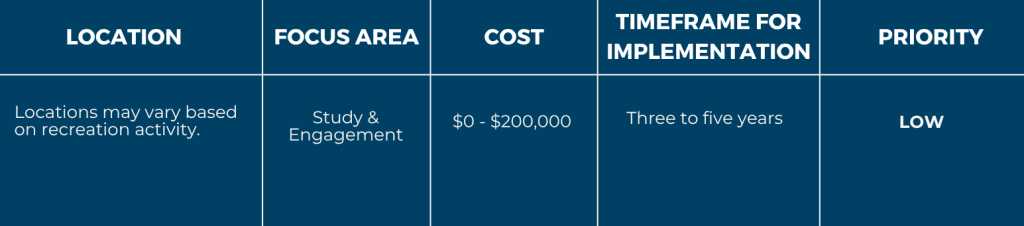
R2 – Gunnison Recreation Access Management Plan
The UGDP supports addressing the continuity of management for recreation access. The access management plan could assess low-head dams and other navigational hazards, collate existing river management plans, identify opportunities for multi-jurisdictional collaboration, and identify needs for access changes in the face of future water availability and use pattern changes.
One goal of the plan could be to provide information to users about the ideal times to recreate based on water levels, where recreation can be accessed, what to expect in terms of different management based on land ownership, and education on river etiquette and safety across a wide range of river flows. This work can be aligned with statewide initiatives like the Colorado Water Conservation Board and American Whitewater’s Quantifying Recreational Impacts and Identifying Enhancement Opportunities Phase 2.
Steps for Implementation
Municipal Resilience
This category represents actions focused on increasing and supporting existing resilience actions for municipal providers.
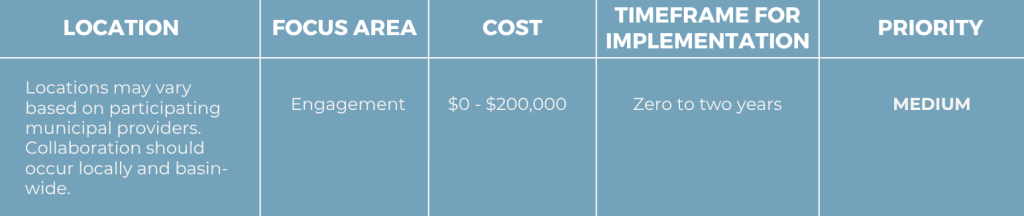
M1 – Municipal Provider Collaboration
The UGDP supports an action specific to improving communication and education among municipal providers across the basin. Routine communication among providers, along with a common understanding of each other’s systems, goals, and needs, will be beneficial as providers implement drought-resilience activities.
Steps for Implementation
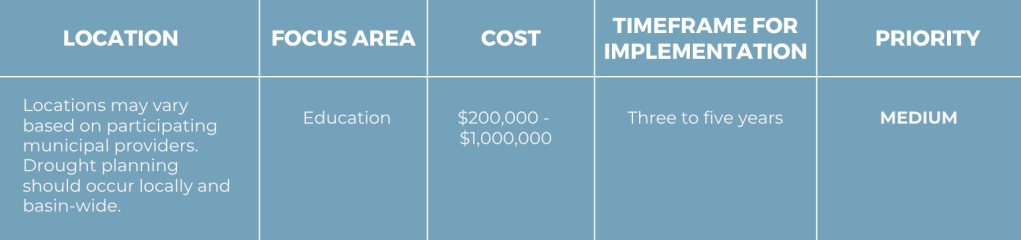
M2 – Drought Response Plan for Municipal Providers
Encourage and support the development of a drought response plan for municipal providers. This planning process would allow municipal water providers to convene routinely to discuss not only drought response actions but also to share information and collaborate on other projects.
Steps for Implementation
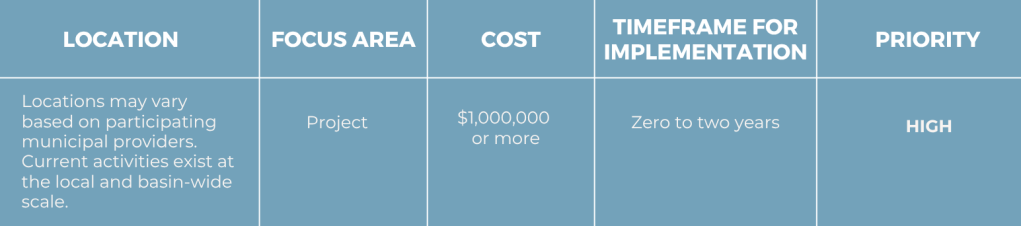
M3 – Source Water Resiliency
Many water providers in the basin are currently implementing actions to help mitigate wildfire risk and drought and create resilience. Each provider is unique in the challenges they face daily or throughout the year. The size of a water provider’s service area and the amount of water treated vary significantly across the basin.
Steps for Implementation
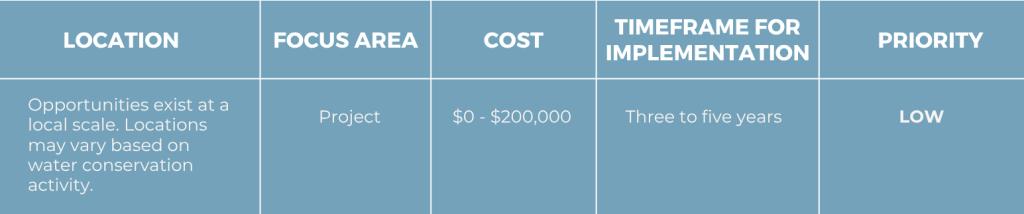
M4 – Native Gardens Demonstration Project
The UGDP supports implementing garden demonstration projects that promote wise water use, native plants, manicured, high-density grass replacement programs, and education on water conservation and xeriscaping.
Steps for Implementation

Newsletter
Subscribe to get our latest updates.
 Upper Gunnison Drought Plan